Wednesday, July 01, 2009


chestnut-mandible toucan


happy crocs


Volcan Arenal at dawn

Costa Rica postscript

After conversing with Costa Rica's scarlet macaws, I returned to find a reader desperate for a copy of a performance piece originally written for Bruno Gerussi's seminal CBC Radio show in the 1970s.
Yes, this was just before Bruno became a TV beachcomber.
Seven Days appears in multiple anthologies and my own column collections.
Why not here?

(appears below)

Seven days

in the beginning,
man created the mudhole and the marsh
damming streams for viaducts
and routing waters for his own benefit
waters, white as crystal, rushed through trenches
trickled through makeshift reed piping
splashed clean into clay bowls
bubbling to do man's bidding

and it was the morning and the evening of the first day
and the seagulls were dying

on the second day, man created the slaughterhouse and the zoo
and the wild animals of the earth
which wandered at will across the planet
instead watched man from behind wire mesh
scruffy lions with sad faces
and elephants, their bottoms calloused from sitting on cement

and it was the morning and the evening of the second day
and the seagulls were dying

on the third day, the buffalo disappeared.
simply disappeared.
and across the pampas
safaris, $1195 per person, sought out exotic creatures
to mount in rec rooms or multiply in cages
and the ice floes ran red
jungle monkeys reeled in terror
antelope, gazelle, deer
stared back thru every rifle's sights

it was the morning and the evening of the third day
and the seagulls were dying

on the fourth day, man created the sewer and sump
and pumps to pipe sewer to sump and sump to sewer
at incredible cost
to nose and pocket.
and the pumps pumped
and the sumps drained
and the sewers flowed
into creeks and lakes
and every drop of sewage makes
an ocean spread across the world
the promised universal apocalypse

and it was the morning and the evening of the fourth day
and the seagulls were dying

on the fifth day, man crated and canned atomic wastes
and made up the word megaton
packing lethal wastes in rusty old drums and concrete caissons
cramming biological uglies into old train tank cars
that ran on undetermined schedules
across the landscape
somewhere, sunken tanks of arsenic are cloaked in barnacles
rust slowly in salt water
and now and then, on october afternoons
underground explosions occur
but smiling spokesman describe them as necessary and safe
as desert floors collapse and islands tremble.
the smiling spokesman swears
the san andreas fault
remains faultless

and it is the morning and the evening of the fifth day
and the seagulls are dying

on the sixth day, man created the additive
which differed in name, but never in purpose
and was gleefully installed in cereals and fertilizers
soft drinks and cookies
field and bug sprays
creams and cosmetics
it was added to everything man ate or drank
but scrubbed from smokestacks
and sewage
and lakes
and eventually,
even the additives had additives
and counter-antidotes to combat the counter-pollutants.
even the experts gave up explaining
exactly what the additives were to accomplish

and it was the morning and the evening of the sixth day
and the seagulls were dying

on the seventh day, there was quiet over all the earth
except for the lapping of waves
and the bubbling of storm drains
and the seagulls were dying
the plankton
the oceans
the atmosphere
the trees were dying

and man
rested

Wednesday, February 11, 2009

BlowHard

Taking a swipe at those who oppose wind turbines off the Scarborough Bluffs, Premier Dalton McGuinty is signalling he won't hesitate to foist "green" energy projects on communities across Ontario.

Saturday, January 10, 2009

Wind Hustlers

So like the medicine shows of old, sky smoothies in suits tour rural Ontario, pitching hopefully rube councils the virtue of Catching The Invisible Wind.

After all, these friends of the Ontario government--and numbered companies who'd like to be buddies of the government--will be subsidized and tax-breaked up the yin-yang to erect 40-storey wind turbines all over the Algonquin boondocks. (Turbines sounds much better than windmills, dude. Very high tech.)

The wind catchers will operate when the wind blows--just 30% of the time--pissing a piddle of power into the grid now and then, but the when cannot be predicted. Or harnessed. Or stored. So the same coal/oil/nuke that currently fuels the grid will grind away 24/7 just like now. Duh.

Wind blows hardest when it knocks down trees or during ice storms when the power grid goes down. Will the blades spin in vain? Or not spin at all? What's wrong with this picture?

How often does the electric grid blink or fail in rural Ontario? There is a more consistent power supply in Ecuador.

Each wind-generated kilowatt hour will be purchased at a guaranteed McGuinty price that is three to five times the price of a kilowatt from existing sources. This surcharge will be passed along to Hydro One customers, like the Retiring Past Mistakes entry on each bill which repents the sins of the 1950s. We have new sins.
Nobody really knows what happens to a 400-foot high windmill in an Ontario ice storm. Can blades the size of jet planes hurl ice slabs? Does the whole structure go down, like a high tension hydro tower?

What happens to wildlife?
Or neighbours within earshot?
How bad are the sound and vibration?
Are there health implications?
How much land will bulldozers tear up to place these suckers?
Who removes them if a cheaper, better source of power makes turibines antiques?
Shut up.

That is why the wind experiment must be carried out east of Algonquin park, where eyesores can easily be erected on heights of land. That these low-per-capita income areas of rural Ontario rely on tourism to survive is... well, what would the word be? Unfortunate? Opportune?

I know! Green!

Ontario must retro-fit all existing Group of Seven paintings to include a large wind turbine next to Tom Thomson's scraggly pine.

If Ontario's cities are the main beneficiary of schemes to feed their wretched excess, shouldn't they lead by example?

I want a wind turbine atop each turret of Queens Park. How about one to replace the communications mast on the CN Tower? Imagine Rochester, green with envy to see a propeller spin atop Toronto's landmark beanie.

Each Toronto skyscraper should have its own rooftop wind turbine to supply--a third of the time--the electric needs of Commerce Court or the Toronto-Dominion Centre. Who needs a grid? Just a long extension cord to the roof. Why they could leave the lights on all night! Whoops, I forgot. They do that anyway.

Where does the wind blow harder than straight in off Lake Ontario?

Eureka!

Alas this is not the plan.

No windmills allowed in David Smith or Dalton McGuinty's yard, thank you.

Rural councils smell a Wind Hustle that will benefit everyone but themselves, and are dragging their feet. Will they get free power? No. Tax benefits for ratepayers? No. Construction gigs? Hah! A little brushing? Maybe.

One rebel council slyly passed a resolution to make no decision in the matter for 10 years.

That prompts Queens Park to fast-track the Wind Hustle and bypass the locals entirely. Shut up! This is called parliamentary democracy.

So we'll get costly power--but only 30% of the time--from unsightly structures taxpayers have underwritten in subsidies and breaks, from towers that won't make much of a dent in the "dirty" supply we use now.

A few favoured companies will roll in free taxpayer cash.

Turbines will go up whether tourists, taxpayers, MPs or locals want them or not. But only in areas that don't have the population or pull to do much about it. What luck!

Why I'm feeling greener already.

Pass the barf bag.

Wednesday, December 24, 2008

The Dog Who Loved Christmas


Shaeffer/Graham Bezant
True, all dogs love Christmas.

These next few days are the officially-sanctioned Dog Disobedience Days.

Nothing dogs do this week is worth the time or trouble to yell at them.

And finally, there is enough going on to interest dogs.

Many of the best holiday events are conveniently staged below knee level, where dogs get the best view.

But one large dog--in his middle years and wise beyond time or space--actually shivers in delight at the first flakes of snow. He quivers on the day he can see his breath. He knows the happiest hours are just ahead. This particular dog sings as The Great Day of Winter approaches: his is a sweet soprano whimper, as clear and determined as a kindergarten kid at a pageant, trying to soar to the tricky "sleep in heavenly piece" moment of Silent Night.

"Gosh," people would tell the mutt, bending down to rub his ears whenever he sang: "You are certainly one dog who loves Christmas."

And he was.
Weeks before the big day, The Dog Who Loved Christmas would track each present as it came in the house, watch coyly as it was wrapped, then memorize its hiding place and wait to be alone. He would unwrap it so it could easily be re-wrapped, two or three times if possible. When the presents were finally moved to high shelves or locked closets, The Dog Who Loved Christmas would take to opening whatever he could reach: eight-packs of toilet paper from the bathroom cupboard, boxes of corn flakes and raisin bran--often in the living room. When everything was finally moved out of his reach, he knew Christmas must be very, very near.

During those delicious last days, if the door opened and The Dog Who Loved Christmas was indoors, he would seize the opportunity to go out. If the door re-opened and he was outdoors, he would come in. Sometimes he would travel in the direction of the door-opener. Other times he would race from the opposite direction, always timing his speed and momentum to squeak cleanly past his doorman's knees.

If anybody tried to direct the animal's activities, a kinder soul was sure to warn: "Hey, leave him alone! You know how much that dog loves Christmas!"

The Dog Who Loved Christmas most loved his tree. It was always set up in the coolest room of the house, the very space the dog himself favoured for sleeping. It was clear the people in the house brought the tree inside as a special present for the dog. He would watch as it was decorated, sniff the unfamiliar indoor odor of pine, sprawl for hours on the floor, using the family as cushions. He liked it when they turned on the lights. Or turned them off. The Dog Who Loved Christmas would sleep under the tree and night and pretend he was camping. He made sure to sleep on the opposite side from where he marked the tree when no one was around. It was, after all, his tree and there was a certain pride of ownership. Sometimes people would stick their finger in the tree's pot. "Yep, it's still wet," they'd say. He was happy to help.

On the day the family decorated the biggest window in the house, The Dog Who Loved Christmas would hurry upstairs. Standing on his hind legs, he would press sweet, heart-shaped dog noses on the undecorated windows of the bedrooms and kitchen. Then he would slip outside to admire his work, with a sidetrip under the porch--the better to coat his paws with clay to decorate the rugs.
"Look!" he imagined visitors might cry in glee. "This house belongs to A Dog Who Loves Christmas!"

The Dog Who Loved Christmas could count on a fine buffet of appealing snacks on the holiday, always placed on coffee tables and low snack trays where he could see them. There were cheeses and round little crackers, sometimes smeared with stinky fish. The dog would feign disinterest and pray for a phone or doorbell to ring, the better to snatch a few. At Christmas, no one kept count. When he was by himself at night, The Dog Who Loved Christmas would help himself to hard candies in a low bowl, suck each piece for a few seconds, then stick it back to try a new flavour. They always wondered why the candy stuck together.

The Dog Who Loved Christmas enjoyed an occasional lick of chip dip and sometimes, to amuse himself, would carry a few potato chips in his mouth to his water dish. There, he'd float them like boats. Then he would whimper pathetically til someone came.

"What's wrong?" they were sure to ask. "Oh poor dog! There are in chips in your water dish. Let me get you a new one." They'd fetch a fresh dish of lovely, cool water, give him a pat and sometimes a treat. Minutes later, there'd be a familiar whimpering, new chips in the water dish and a new victim to say, "Poor dog."

The Dog Who Loved Christmas rolled happily in the wrapping paper on Christmas Eve and--since he growled menacingly at anybody who tried to retrieve wrappings--got to guard the paper overnight. It was collected the next morning, no piece bigger than a torn movie ticket, while the dog took his morning walk. It reappeared Christmas Eve as confetti.

On Christmas Day, The Dog Who Loved Christmas would sit politely under the dining room table. He was so quiet visitors had to peek underneath to convince themselves he was even in the house.

"I can't believe it!" they would cry. "My dog would be begging, barking and carrying on! Why I'd never know your dog was even in the room! What a Good Dog!" Dozens of times, hands would appear under the table offering turkey and tidbits.
The Dog Who Loved Christmas learned at a very young age that dogs who never beg get more turkey than those who do. Every guilty person at the table eventually offered something, a carefully-chosen pay-off. Indeed, some years, so much food was gingerly collected below the laughter and conversation above that The Dog Who Loved Christmas would have to slip away to the basement two or three times during the meal and ralph everything he'd eaten thus far into a cool corner. He'd always upchuck against an outside wall, so no incriminating evidence would be found til Easter. Sometime he re-ate it for snacks. Then it was back upstairs for another pound or two of dinner.

After the meal, The Dog Who Loved Christmas would race outside with the kids. It was his duty to destroy forts and snowmen as quickly as tots could build them. Bundled in snowsuits, the kids could barely feel his nips. The smaller ones had difficulty walking. The Dog Who Loved Christmas would grab them by their parka hoods and drag them backwards through snowdrifts, playing crack the whip. He did this only with wee ones who couldn't really talk, so they could not report him to the authorities. And of course, bigger kids all thought it was funny.

On Christmas night, The Dog Who Loved Christmas would sprawl on his back under the tree, fat and happy, his legs splayed like a broken toy, his mouth open, and snore like a horse.

Every year at about midnight, they would take his photo for the family album.

There were eight years' worth of pictures of the animal, paws to the sky and snoring. So cute, so content, under his tree.

"That Dog Sure Does Love Christmas," somebody would always whisper, as the camera shutter clicked. Sometimes his eyes would flutter and he even heard them say it. It made him very glad to please them so.


dunford/pagesix 1986

Swim with the sharks


So a few feet underwater, six miles off the north coast of Oahu, I feel a tap on my shoulder. A torpedo-shaped Galapagos shark coasts by. I come up for air.

"Your knee was outside the shark cage," sez my responsible pal.

This is good to know.


"Shut up," I tell him, just as you would.

In the bobbing cage, sucking a snorkel tube, circling sharks ripple in sunlight, all IMAX, Discovery Channel and light show. It is an irresistible swim of beautiful greys and blues.

Fools try to touch the sharks, a hypnotic arm's length away. This is why God gave us liability waivers.


Never give them a knee.

Wednesday, August 22, 2007

Friday, April 13, 2007

Teachers heart beavers

Building a better dam

If BCE were in the business of selling beavers, don't you think they might do better?

Frank and Gordon--the fuzzified beav pitchmen for Bell services in TV and print ads--are the most attractive part of the company.

(Bell's choice of rodents as corporate spokesfolk is some sort of inside joke. Most customers get it.)

But alas, Bell sells long distance, which is why so many of us are with Primus.

And cell phones, which is why I use Telus.

And home satellite services, which is why I'm with Star Choice.

And internet broadband services, which is why I chose Xplornet.

Apparently somebody at the Ontario Teachers Pension Plan has noticed this. Bell's biggest shareholder is "exploring" its options.

My advice: keep the beavers.


Lose the rest.

Monday, April 02, 2007

Abandoned blog?

So the question becomes: if you have a life, why would you waste a great deal of time writing a blog?

1. Ego
2. Delusion
3. Revenge
4. Self-esteem issues
5. Boredom
6. Brain ooze
7. Ran out of DVDs
8. Over-medicated. Again.
9. New pictures of Vancouver Island trip.

I choose the last.

Sunday, November 26, 2006

Wisconsin ... it's nice

I've been in rural Wisconsin a few times recently.

Wisconsin is more than the World Capital of Water Parks.

(I believe the Interstates were only built to connect the water parks.)

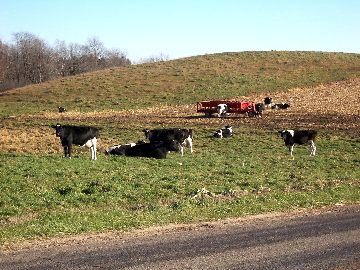
It's more than beautifully-groomed cows, and Amish buggies double-parked at the local Wal-Mart.

It's humble, sweet and loveable.

And of course, there are the cranberries.
Warrens is the site of the annual Cranberry Festival (aka Cranfest) ...

The grandest collection of vendors, craftsies and crazies you ever did see.
The caramel-dipped, chocolate-covered cranberries are delicious.
Know your cranberry bog ....

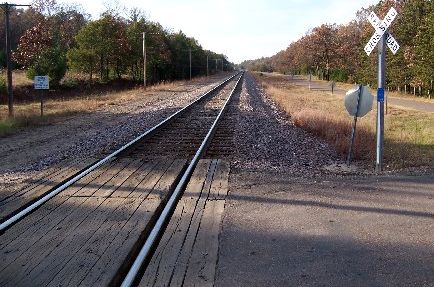
And never stand on the tracks where trains take them away.
There are puppies in the parks ... and sunsets.

Very nice.

The penny drops....

So when you were a kid, didn't you always wonder why a Crayola crayons box had so many shades of brown in it?

In a box of 48 crayons, there were burnt umber, sienna, crimson.

In a box of 100 crayons--and yes, I knew a kid who had such a treasure--there were two shades of cinnamon, amber, tan, beige, scarlet.

Only as an adult do you realize why you would need such an infinite variety of colors that seem to be drawn from just one corner of the palette.

It's called ... Fall.

Landing....

The island...

No summer is long enough.

The sweetest joy as each Ontario summer piles upon summer, is taking friends secret places they've never been.

A secret place shared is never erased.

No imaging scheme, no gigabyte stick has yet been invented that can lock the bubbling curve of one August afternoon's light, time, water and rock quite so well as the human heart.

We ... were ... there.

Tuesday, August 08, 2006

Harris Bay...


If you recognize the landmark rock in this photo, you are among the very lucky humans who have found ... Harris Bay.

How many kayaks, canoes, bass boats long for this perfect place?

For some of us it is a cove, an amazing landscape, that begins adventures.

It is the backdrop to laughter, friends, lovers, wading sheepdogs. It is Ontario summer. Maps, backpacks and beer. It arcs over decades.

When I remember a writer's line about "that high late summer sunshine, the lap of cool water on a hot rock and a perfect curve of time" ... this is the rock that always materializes in my imagination.

The rock rules over a lake at which there is always a wildly beautiful, rocky campsite ... waiting.

Nothing I have seen or photographed in the last five days prepared me for my visit to Harris Bay today.

I went there to photograph the landmark rock for a friend I hoped to take there. He likes rocks. It is ... or was ... a perfect place.

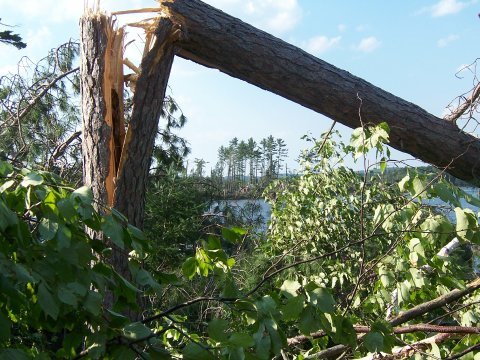
It was eaten by a tornado five days ago.

Can nature devour your past in a snap second?

A tree fell in this forest.

Damn.

Monday, August 07, 2006

Tornado in Combermere


Opeongo Trail Resort, Combermere ON

Tornado upgraded to Level 2

Environment Canada resassesses twister in Combermere based on photographs ... winds 181 to 240 kph

Tornado upgraded to Level 2
Environment Canada reassesses twister in Combermere based on photographs

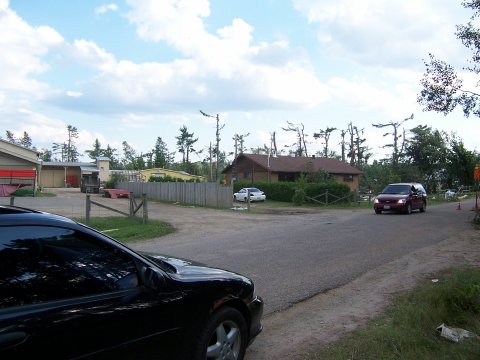
The town was savaged by a Level 2 or "strong tornado" with winds from 181 to 240 km/h, Geoff Coulson, an Environment Canada meteorologist, said yesterday.

Based on the amount of damage -- healthy white pines were snapped off and de-barked -- winds probably topped out at about 200 km/h.

The upgrade is based on the photographs taken Thursday and discussions between a tornado researcher in Toronto and an investigator on location.

The worst of the damage was through the resort area and into the town, a swath 300 to 400 metres wide and two to four kilometres long.
--Ottawa Citizen


Combermere bay near docks and marina


Combermere, intersection of Hwy 62 and Old Barrys Bay Rd


Kamaniskeg Lake


Looking north from Hwy 62


South Kamaniskeg Lk Rd


Combermere, Opeongo Trail Resort area from Hwy 62


Brook and waterfall area, South Kamaniskeg Ld Rd


Houses, S. Kamaniskeg Lk Rd near Sand Bay camp


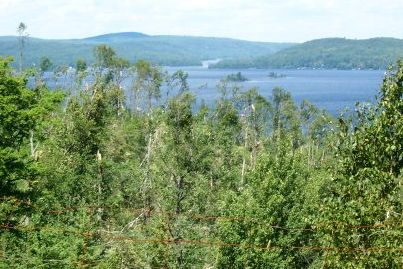
View from scenic overlook on Hwy 62 is stripped of most large trees


Uprooted trees collapsed on cottage and car, S. Kamananiskeg Ld Rd